Default image for pages

For me, the word “tableau” used to provoke the French definition: a painting or canvas. Aficionados of art history may even associate the word with a style known as “tableau vivant”, or “living picture“. As you may have guessed, the word now holds new meaning for me- although in many ways the definition still rings true.

About one year ago, our team at Catalyst Kitchens began using Tableau software to better analyze and visualize the columns and rows of data collected from our membership network. If you’re not familiar with Tableau, their products are designed to help people better see and understand their data in order to “discover opportunities, answer questions you didn’t know you had, and share data stories”. It’s like Microsoft Excel’s stylish bilingual cousin.

[youtube https://www.youtube.com/watch?v=Qo6W-oBO9XM&w=560&h=315]

It’s no secret that the nonprofit sector has historically underutilized the power of data. A 2016 study from the Nonprofit Hub found that 60% of non-profit organizations surveyed were not using data consistently to make decisions. However, the study found that 97% reported an interest in learning how to use data more efficiently.

We’ve been collecting outcomes data around our food service job training programs at Catalyst Kitchens for years. This enabled us to report annually on our collective impact- such as the cumulative number of people trained through our programs or the number of meals served to individuals in need. We are now able to bring this to the next level through our work with Tableau, and more specifically through the generous support of the Tableau Foundation.

The Nonprofit Hub found that 60% of non-profit organizations surveyed were not using data consistently to make decisions.

Next week we’ll share outcomes bench-marking reports with all of our member organizations. For the first time, the non-profits in our network will have a basis of quantitative comparison against other training programs and a better understanding of which programs are most similar to them. Members will have the ability to filter data sets for metrics such as number of trainees graduated and target population served to ensure that the data insights are as relevant as possible.
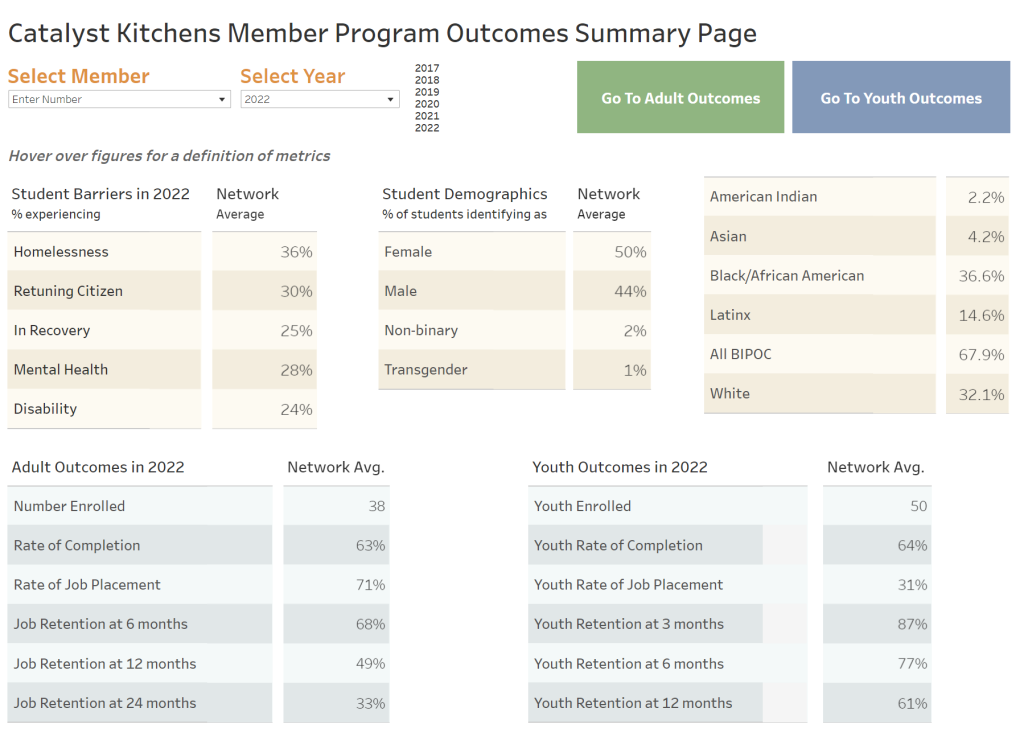
Snapshot of a Catalyst Kitchens bench marking report.

These reports will serve to provide industry standards that help define success and target opportunities for improvement. We see this kind of analysis as a shining example of why the Catalyst Kitchens network exists and simultaneously feel we’ve just scratched the surface of what lies ahead. Thank you, Tableau Foundation, for supporting data science in the social impact space!

Citations:

Business innovation and social enterprise are a natural pairing.  When the aim is to do charitable work while staying in the black, sometimes the answer is to try something that nobody else has tried before.  This is exactly where Will and Nancy from Second Harvest Food Bank in Orlando, FL found themselves a few years ago.  They knew they could create healthy meals for local schools at a good price, and utilizing food pathways from Second Harvest.  Their kitchen –  an innovative design for a renovated laundry room capable of pumping out 37,500 meals per week – was up to the task.  But they knew their organization had neither the capital nor desire to buy and manage a whole fleet of drivers and delivery vehicles.

Enter Michael from Eagle Express Couriers.  With Will and Nancy’s vision and Michael’s expertise and willingness to re-invent his fleet, they embarked on a mission to create a vehicle system with the flexibility to deliver hot and cold meals at the proper temp, in the proper time, and at the right price.  Michael recalls that his first thought after meeting with Will and Nancy was “I just agreed to do something, and I don’t have any idea if I actually know how to do it!”

shfb-truck.jpg

Together they pushed ahead and, with Second Harvest’s guidance, Michael custom-built a fleet of 5 trailers.  There were bumps in the road, of course.  The first generators they bought weren’t as advertised, so they upgraded.  Then came aluminum frames to save on gas cost and allow for lighter trucks to pull them.  Then GPS-based temperature logging software to comply with regulations for child meals.  And recently, Bluetooth radios so that meal delivery at the schools could also double as an impromptu dance party for the kids.  Each trailer can transport and serve 900 hot or cold meals per delivery run twice a day for a total of at least 1800 meals.

As the relationship with the two companies has grown and developed – adding more trailers, meals, drivers, and delivery routes – they’ve managed to drastically reduce costs.  The target overhead per meal for driver and delivery is now around just $0.20.

Michael, who owns a second courier company in the Philadelphia area, and has contacts with the CLDA members across the country, thinks this model could work elsewhere.  He has already built trailers or advised on trailer projects with food banks in New Jersey, Monmouth, New Orleans, and Houston.  Michael says these relationships do make sense for his business too.  Will and Nancy see the potential of the Catalyst Kitchens mission in any space, large or small.  They want other food banks and inspired individuals to see the possibility of kitchen operations wherever they are at, laundry room or otherwise.  Together, they believe in the work being done, and the power of consistent innovation to advance the network.  Michael sums up their mindset well, “You just go out and try to hit a single every day.  I’m not going to become a millionaire from this, but that’s not the point.  When a customer like [Second Harvest] has an idea, you don’t say no.  You say ‘yes, and let’s figure this out together’.”

A final note and update since these interviews were originally conducted: As part of the relief efforts associated with Hurricane Irma, Second Harvest Food Bank produced and distributed around 30,000 hot meal for shelters, distributing food across 7 counties through a the combined efforts of the American Red Cross and their own delivery trailers.

shfb-irma.jpgMichael Frankel can be contacted through his company, Eagle Express Courier at their website – http://www.eagleexpresscouriers.com/

Will and Nancy can be found through the Catalyst Kitchens Member Directory.